
The SMS firewall that shows its work.

Zapim sits in your signalling path, judges every message against rules you can read and models that run on your own node, and explains each decision to the people who run the network.

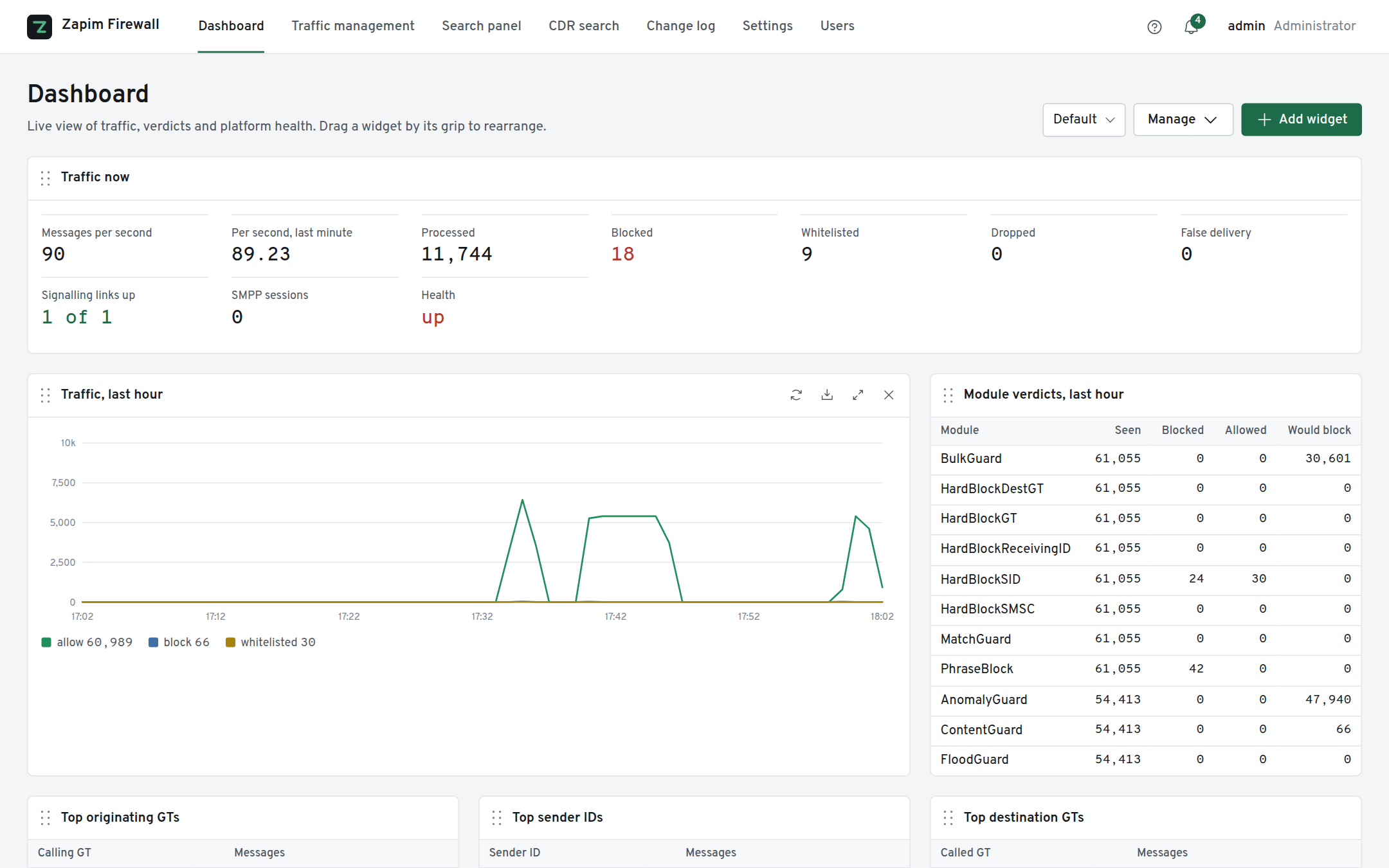
The Zapim Firewall dashboard: live message rate, blocked and whitelisted counts, traffic by outcome over the last hour, module verdicts and top originating global titles.

What reaches your subscribers is your reputation.

Every operator carries traffic it never agreed to: phishing texts that borrow a bank's name, campaigns arriving over grey routes, faked delivery attempts that never asked the HLR, and bursts that exist only to probe your numbering plan. Zapim stops each of these at the signalling layer, before a handset rings.

A telephone exchange patch panel with green cords, one of them unplugged.

Smishing and brand abuse

Messages that impersonate banks, couriers and government services. Blocked by sender identity rules, phrase rules, near-duplicate detection and a text classifier that learns from your own feedback.

HardBlock Sender ID, PhraseBlock, BulkGuard, ContentGuard

Grey routes and spoofed origins

Traffic from global titles you never interconnected with, or from senders whose network does not match the route it arrived on. Blocked by global-title and SMSC rules with origin-mismatch checks.

HardBlock GT, HardBlock SMSC, SpoofGuard

Faked and forced deliveries

Delivery attempts that skip the routing enquiry, or routing enquiries used to harvest subscriber locations. Zapim correlates the enquiry with the delivery and hides your subscribers behind a virtual identity.

FakeGuard, HomeRouting, MAPScreen

Floods, scans and anomalies

Sudden volume from one source, one sender sweeping through thousands of numbers, or a route that quietly triples overnight. Detected by rate limits, scan detection and a per-source statistical baseline.

FloodGuard, ScanGuard, AnomalyGuard

How a message is judged.

Your STP hands each message to Zapim and takes it back a moment later. In between, every module in the rack looks at it, and one table decides. Nothing is buffered, nothing is rerouted; if the firewall is unreachable, the STP bypasses it.

Operator STP loopback routing message in answer out Firewall rack Decision table waiting
Green lamp module saw nothing wrongRed lamp module matched a ruleWhitelist wins over any blacklist unless MatchGuard decides
Module verdictsResultWhat the sender receives
MatchGuard says whitelistAllowedNormal delivery
MatchGuard says blacklistBlockedThe MAP error you chose, a silent drop, or a false delivery
Any module whitelistsAllowedNormal delivery, whichever blacklists fired
Any module blacklistsBlockedThe error code of that module or rule
Nobody objectsAllowedNormal delivery, recorded like every other message

Passive modules take part in every evaluation and count what they would have blocked, but never change the result. That is how a new rule is rehearsed on live traffic before it is switched on.

Seventeen modules, one rack.

Each module does one job and reports it. Switch any of them between passive and active, edit its rules, attach a threshold alert, and read its statistics without leaving the page.

  • Identity
  • HardBlock GTOriginating global title, with origin-mismatch detection
  • HardBlock SMSCService centre address for MO and MT traffic
  • HardBlock Sender IDAlphanumeric and numeric senders, long-code blocking
  • HardBlock IMSI, Destination GT, Receiving IDSubscriber, destination and do-not-disturb lists
  • Content
  • PhraseBlockPhrases, prefixes, suffixes and regular expressions
  • BulkGuardIdentical and near-identical campaigns by text fingerprint
  • ContentGuardOn-node smishing classifier that learns from your feedback
  • Behaviour
  • FloodGuardRate limits per source, destination, sender or tunnel, with spike detection
  • ScanGuardOne source sweeping through many destinations
  • AnomalyGuardStatistical baseline per source; flags what breaks from it
  • Signalling
  • SpoofGuardHome subscribers claimed by the wrong network
  • FakeGuardDeliveries without a routing enquiry
  • HomeRoutingVirtual identities for outbound roamers
  • MAPScreenAny MAP operation, per originating prefix
  • MatchGuardCompound rules across all of the above; its verdict overrides
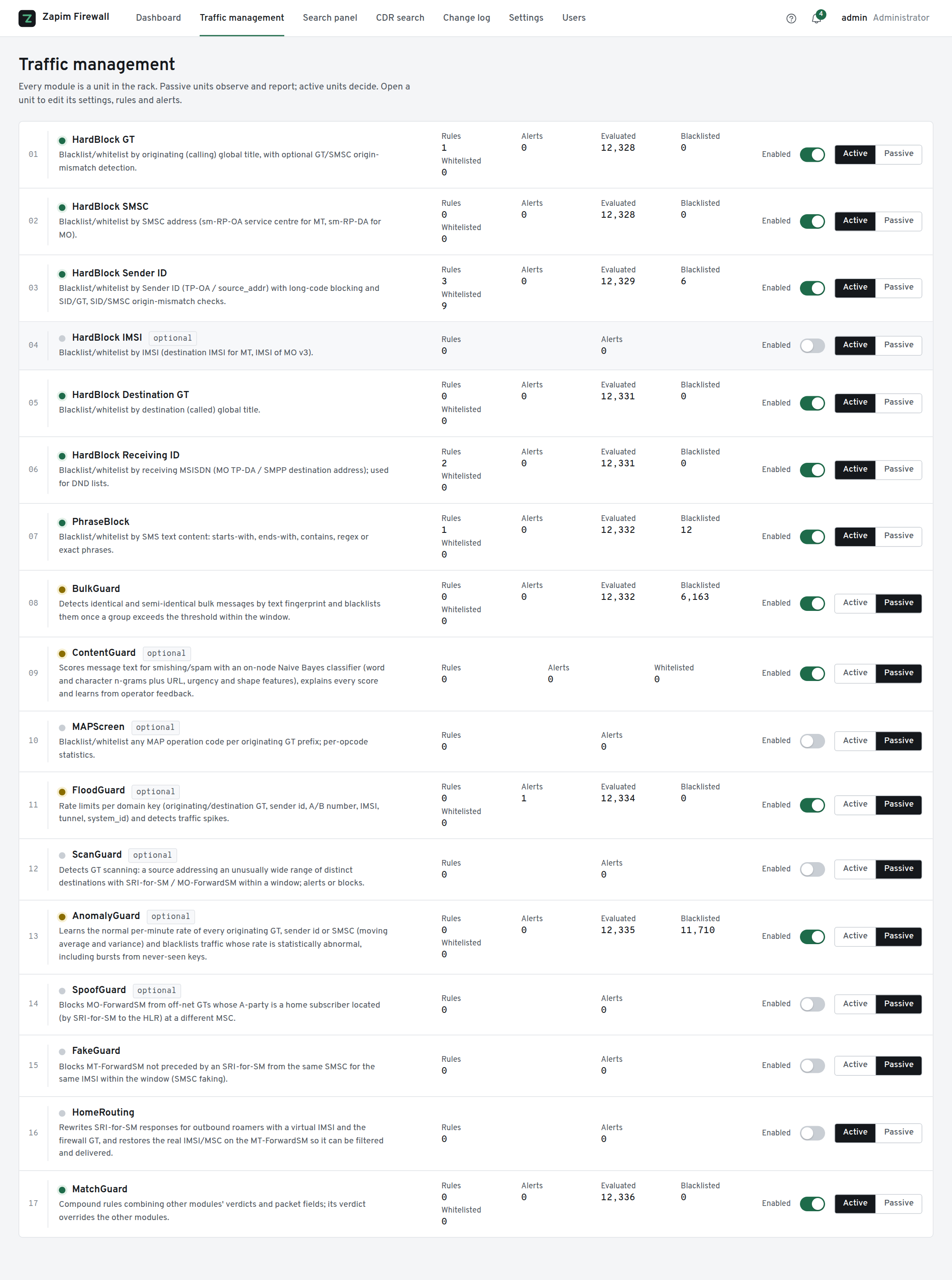
Traffic management: the rack of seventeen module units, each with a state lamp, counters, an enabled switch and an active or passive selector.

Where the models help, and where they stay out of the way.

Rules are precise but they only catch what you already know. Three modules learn from your traffic instead. All three run inside the firewall node: no message, model or statistic ever leaves it, and every score comes with the reason behind it.

ContentGuard

A text classifier you can teach in a minute.

Scores the text of each message for smishing: the words and character patterns it uses, whether it carries a link, whether that link is shortened or hides behind a raw address, how much urgency it pushes. Every verdict lists the five signals that weighed most.

When it gets one wrong, an analyst pastes the text, presses teach, and the model adjusts immediately. It also learns from what your other modules block, so it keeps up with the campaigns your rules already caught.

Runs on the node. Explains every score. Starts passive, so you can watch it before it decides.
AnomalyGuard

Knows what normal looks like for every route.

Keeps a moving baseline of messages per minute for each originating global title, sender or service centre, and raises a flag when a source departs from its own history: a new route that arrives at full speed, a known sender that triples at 3 a.m.

No thresholds to guess. A flagged burst is never learned as the new normal.
BulkGuard

Sees the campaign, not the message.

Fingerprints message text so that a thousand variations of the same offer, each with a different code or link, are recognised as one group. You can block a group with one click and see which senders and routes carried it.

Groups are searchable by sender, route, phrase and time.

What these models are not. They do not read your subscribers' messages to a cloud service, they hold no opinion about language or intent, and they do not replace your rules. They rank what your rules missed, show their reasoning, and wait for a person to agree.

A console built for the people on shift.

Light, quiet and dense where it matters. Identifiers line up, state is always a word and not just a colour, every table exports, and the change log records who touched what.

Evidence, not anecdotes.

Every decision leaves a record you can search, export and send to the people who ask why a message did or did not arrive.

Call detail records

One record per message with the verdict of every module, written to CSV on a schedule and searchable by subscriber, sender, route and outcome.

Statistics without personal data

Minute-by-minute counters by route, sender, operation and outcome. Saved searches, scheduled reports by email, CSV and PDF with charts.

Alerts that reach someone

Threshold alerts per module, delivered to the console, by email and by SMS, with a cooldown so a long incident is one alert and not a hundred.

A complete change log

Every sign-in, rule change, setting and import, with the user and the address it came from. Configuration is versioned and restorable.

Fits the network you already run.

SS7 over SIGTRAN

Connects to your STP as an M3UA application server over SCTP. Loopback routing by point code or translation type, exactly as your STP team expects. Undecodable packets pass through untouched.

SMPP, transparently

Sits between content providers and your SMSC without new credentials. Each tunnel gets its own identity so the same rules and statistics apply to application traffic.

Two nodes, one point code

The STP load-shares across nodes. When one node's buffers fill, it hands traffic to its peer; when both are down, the STP bypasses the firewall. Nothing is ever black-holed.

Your directory, your monitoring

Sign-in through Active Directory or LDAP with group-to-role mapping, three roles plus per-user permissions, Zabbix template and Prometheus metrics out of the box.

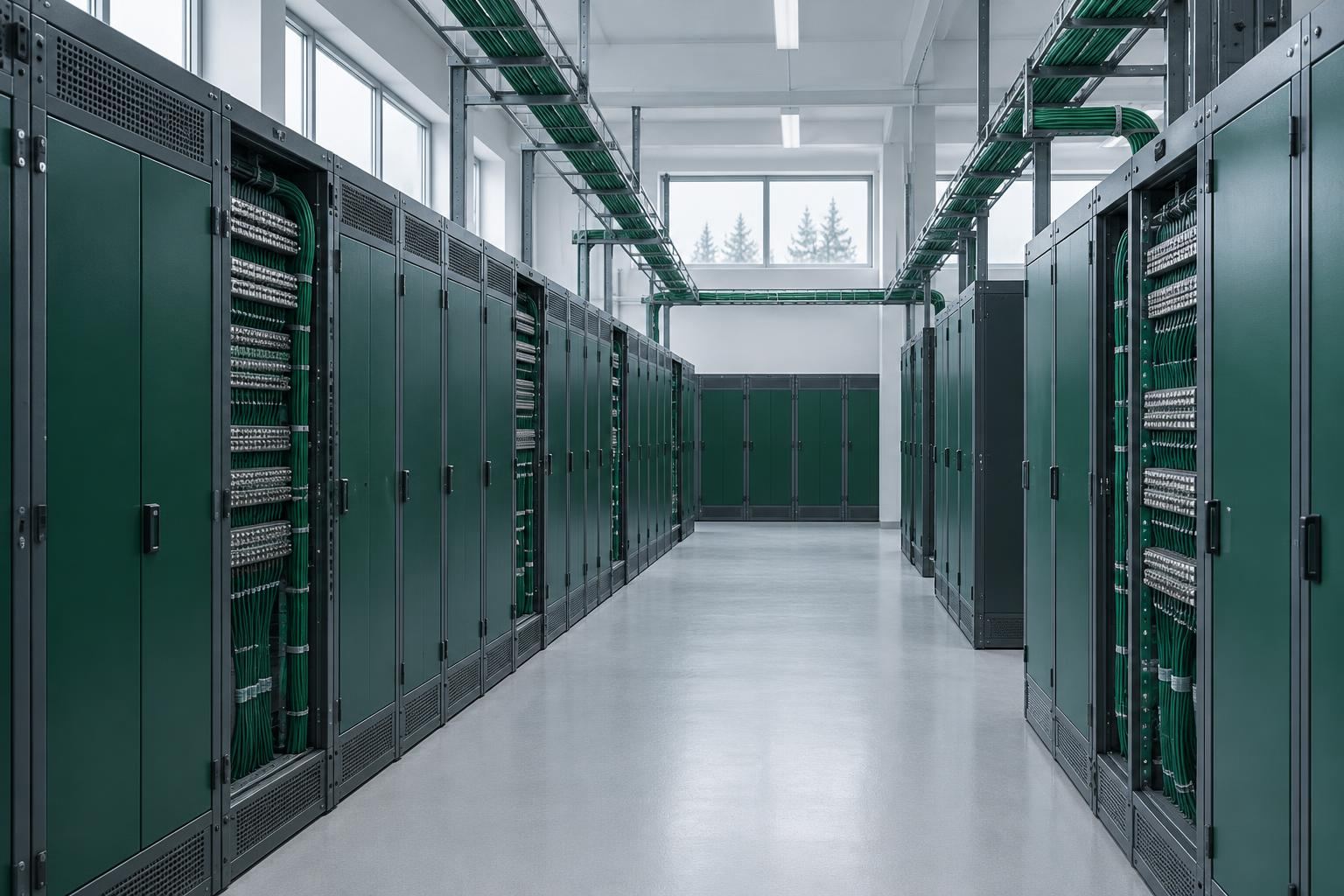
A quiet telephone exchange switching room with rows of green equipment racks and cable trays.

Built to be trusted with signalling.

Content never crosses the management networkThe console carries settings and aggregate statistics. Message text is stored only if you switch it on, and only on the node.
Works without the internetThe console, its fonts and its map ship inside the binary. Nothing is fetched from a third party.
Survives a database outageThe engine boots from a local snapshot of the configuration and keeps filtering while the database is away.
Rehearse before you enforceEvery module and rule can run passively on live traffic, counting what it would have blocked, before it is allowed to decide.
A single static binaryNo runtime, no package tree to patch, one file to audit. Pure Go, including the signalling codecs.
Fuzzed where it faces the networkEvery protocol decoder is exercised with random and malformed input as part of the build, so a hostile packet cannot take the node down.

Running in an afternoon.

One binary, one configuration file, an Ubuntu virtual machine with two cores. The same build runs in Docker for a lab and on Azure with the deployment template we ship.

# one node, with its configuration
zapimfw -config /opt/zapimfw/config.json

# check a configuration before applying it
zapimfw -config config.json -check

# a complete lab on a laptop: STP, SMSC and traffic
zapim-sim stp  -listen 127.0.0.1:2905
zapim-sim smsc -listen 127.0.0.1:2775
zapim-sim load -mps 600 -duration 60s
  • Sized for the specification's peak of 600 messages per second per node; in the lab a decision takes well under a millisecond.
  • Configuration is versioned in the database, snapshotted to XML on every change, and exportable as one JSON file.
  • Backups of configuration, rules and records with a seven-day retention, restorable with one command.
  • Health endpoint, Prometheus metrics, spec-format logs and optional packet capture for the STP team.
  • Azure: a Bicep template creates the network, the security rules and one or two nodes from a release archive.

See it on your own traffic.

We set up a lab against a copy of your routing configuration, replay your traffic mix, and walk your team through the console. Then you decide what to switch on.